How to Read a Quadrangle
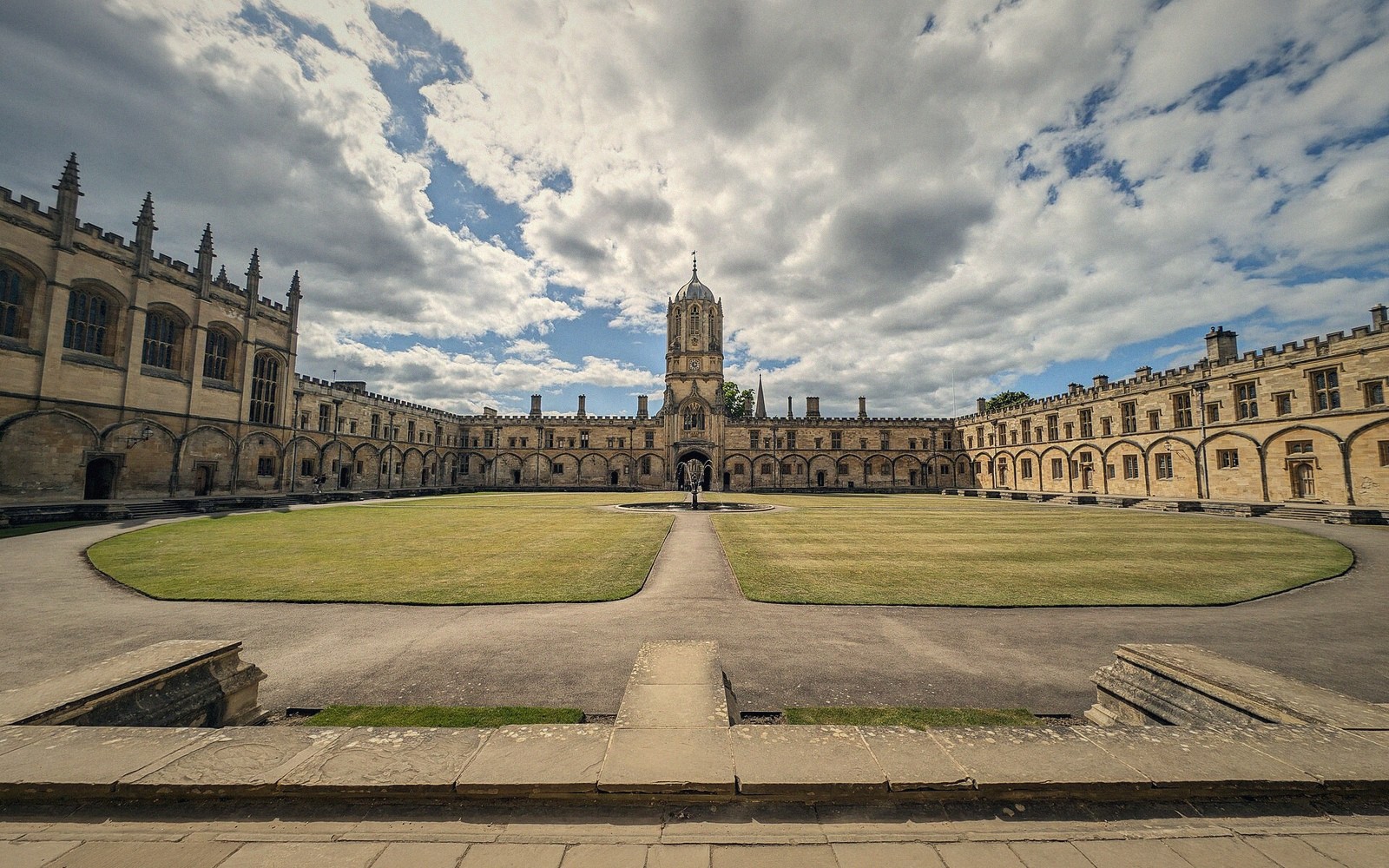
Every Oxford college is a variation on the same idea. Once you know the grammar, you can walk into any quad and understand what you're looking at.
The Shape and Why It Exists
A quadrangle — quad, court, garden, whatever a particular college chooses to call it — is an enclosed courtyard, usually rectangular, with buildings on all four sides. The form looks medieval because it largely is: colleges borrowed the layout from monasteries, which had already worked out that an inward-facing building keeps weather out, community in, and the noise of the city at bay. Oxford's oldest surviving quads date from the fourteenth and fifteenth centuries, and the logic hasn't changed since. Stone walls on the outside, windows on the inside, a single gateway through which everything and everyone passes.
That gateway is the first thing to learn. The entrance arch is almost always the tallest and most decorated element of the whole facade — because it was meant to be. It signals status, it controls access, and it frames the quad beyond as something you have earned the right to see. Step through it and you've crossed a threshold that the college has been managing, in various ways, for centuries.
Gate, Lodge, Hall, Chapel: The Working Parts
Just inside the gate, usually tucked to one side of the entrance passage, is the porters' lodge. This is not a ceremonial leftover. The lodge is the operational nerve centre of the college: it controls who enters, holds keys, takes deliveries, and decides — with considerable latitude — whether a visitor is welcome to walk around or asked to leave. The porters know everything about what is happening in the college that day. A polite word with them is always worth more than hesitation at the gate.
From the lodge, look across the quad. The hall — the large communal dining room — is almost always easy to find. It tends to occupy the most prominent wall opposite or adjacent to the gate, raised above ground level by a flight of steps, with tall windows. In the medieval scheme, hall was the centre of communal life: eating, meeting, hearing announcements. The kitchen was behind it. That relationship usually still holds, which means a service yard or back lane runs behind the grandest-looking wall in the college.

The chapel is typically at right angles to the hall, sharing the quad's perimeter. Its position varies, but its scale rarely does — big enough to seat the whole college, with a tower or spire that reads from outside the walls and lets you locate the college from two streets away before you've even found the entrance. Many college chapels are still in daily use, which means they close at unpredictable times and open at others. Some are among the finest small ecclesiastical interiors in England, with almost nobody in them.
The fourth wall — the one not claimed by hall, chapel, or gate — is usually accommodation: the residential staircases where students and, in older colleges, fellows live. These are not open to visitors. They don't need to be. The quad itself, if you're allowed to stand in it, tells you enough.
Many college chapels are still in daily use, which means they close at unpredictable times and open at others.
What the Variations Mean
No two colleges are identical, and the deviations from the template are where things get interesting. A college with multiple quads is usually an old one — the institution expanded, acquired adjacent land, and built inward rather than outward. Christ Church has a first quad on a cathedral scale; Magdalen wraps its cloister around a lawn. Some colleges have a garden quad that's barely a quad at all, open on one side, the wall replaced by iron railings and a view of the college garden beyond. This is usually the newest part.
The materials and the stonework change, too. Oxford's building stone weathers and darkens at different rates depending on where it was quarried and when it was laid. A quad that mixes pale ashlar with darker, heavily worn stone is telling you about phases of construction across centuries — a building campaign interrupted, a bequest that funded a new range, a Victorian restoration that replaced what age had destroyed. You don't need to know the history to read the seam.
What does change significantly is access. During term — the teaching periods when colleges are working — many close entirely or limit visitors to a small section. Outside term, more quads are open, though some of the most famous attract enough visitors that the college restricts entry to manage the numbers. The standing rule is to check on the day at the gate; a closed sign may mean closed entirely, or may mean closed until two o'clock. The porters' lodge is the only source worth trusting.
What You're Actually Looking At
The quad is not decorative. It is functional architecture that happens, over time, to have become beautiful. The worn steps, the uneven cobbles or gravel, the lawn that no visitor is supposed to walk on — all of it is the residue of a working institution that has been doing the same things in roughly the same place for a very long time. When you stand in a quad you are standing in the gap between the hall and the chapel, between the gate and the garden, in the exact space the original builders left open because they understood that a community needs somewhere to gather that isn't inside a building. That is what a quadrangle is for. Everything else is variation.
Related