The Pitt Rivers Is Not Arranged the Way You Expect
Typological display, and what it does to how you look.
A museum that organises by type, not by origin — and why that changes everything you notice
Walk into most museums of world culture and you are immediately sorted by geography. Africa here, the Pacific there, the Americas in wing C. The objects are anchored to their regions of origin, grouped with near-neighbours from the same continent, the same century, the same civilisation. It is a system that makes institutional sense. It is also a system that tells you, quietly but firmly, that the most important thing about any object is where it came from.
The Pitt Rivers Museum disagrees. It is arranged typologically: objects grouped by what they are and what they do, not by where or when they were made. Masks from West Africa hang near masks from the Pacific Northwest and the Andes. Fish-hooks from a dozen different ocean cultures sit in the same case. Musical instruments, weapons, textiles, amulets, and models of boats are gathered by function across every culture the collection has ever reached. The effect, on first encounter, is somewhere between bewilderment and revelation — and then, very quickly, becomes addictive.
Why the arrangement exists, and who decided it
The collection began as a donation from General Augustus Henry Lane Fox Pitt Rivers, who gave his personal collection of ethnographic and archaeological objects to the University of Oxford in the nineteenth century. Pitt Rivers was a military man and an amateur anthropologist of the Victorian type — convinced that human cultures evolved in stages and that objects could be sequenced to demonstrate technological progress. His typological arrangement was meant to support that theory: line up the fish-hooks from crude to complex, and you would see, he believed, the arc of human ingenuity.
The evolutionary framework he imposed is long since discredited, and the museum's curators have spent decades — and continue to spend them — working through the ethical and intellectual consequences of a Victorian collection built in the era of empire. But the typological structure was kept, and kept deliberately. It was understood, over time, to do something more interesting than Pitt Rivers intended. When you take away the national and regional labels as the primary organising principle, you are forced to look at objects on their own material terms — their shape, their material, their function — before you reach for their cultural context. You start with the thing, rather than the category.
Whether that is the ideal way to encounter the world's material cultures is a legitimate debate, and the museum neither claims to have settled it nor pretends the arrangement is neutral. That tension is part of what makes the visit unusual. This is not a museum where the interpretive framework is invisible. It sits right there, in every case label, every curatorial note, every moment where you find yourself standing between a Yoruba mask and a Nuu-chah-nulth one and asking what exactly you are being invited to compare.
The building, and how to enter it
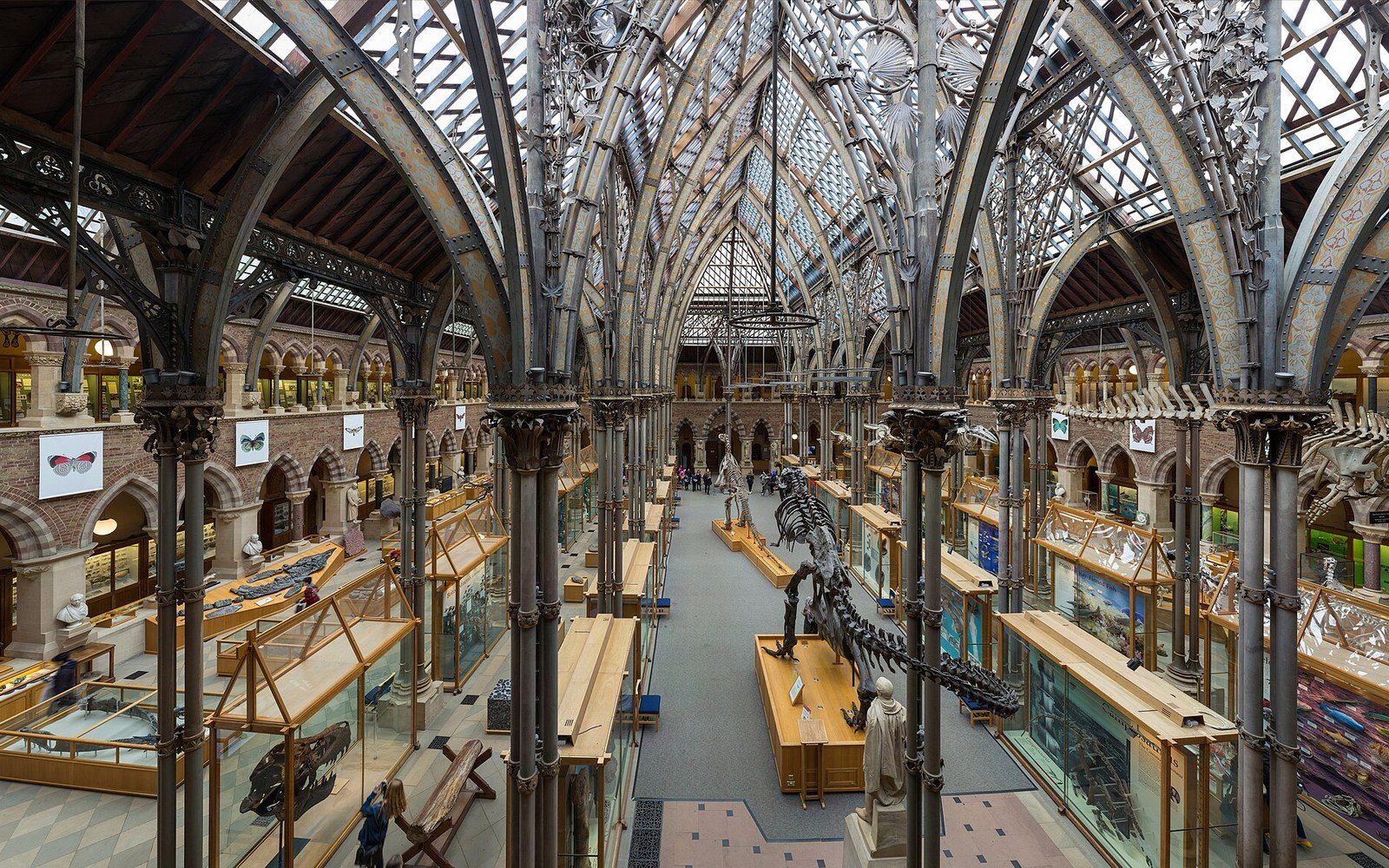
The Pitt Rivers occupies a Victorian Gothic iron-and-glass court bolted onto the back of the Museum of Natural History, which faces Parks Road. You do not enter the Pitt Rivers from the street directly — you pass first through the natural history museum, under its soaring glass roof and past its dinosaur skeleton, and then through a doorway at the back. The transition is abrupt and deliberately atmospheric. The natural history museum is light, airy, scientifically legible. The Pitt Rivers, by contrast, is dim, dense, and arranged in three tightly packed gallery tiers around a single court. The cases are old and dark-wooded. The labels, though regularly updated, often retain something of an older register. The whole room smells faintly of wood and old textile.
The collection holds well over half a million items, though only a fraction are on display at any given time.
There are objects everywhere. The cases run from floor to ceiling. The gallery tiers are crammed. The collection holds well over half a million items, though only a fraction are on display at any given time. That fraction is still, by any reasonable measure, an overwhelming number of objects. The temptation is to sweep past quickly; the museum rewards the opposite. Stop at a single case. Read its label — the type, then the examples. Then look at what the type does not quite contain: the object that almost fits, the exception on the end of the shelf, the thing that a slightly different culture solved a slightly different way.
What to actually look for
The shrunken heads — tsantsas, made by Shuar and Achuar peoples of the Amazon — have been among the museum's most discussed objects for years, as the museum has engaged publicly with questions of acquisition and appropriate display. The museum has made substantive efforts to consult with descendant communities and review what it holds and how it holds it. Whatever you think about the ethics of display, these conversations are live and documented, and the museum's own position on them is worth reading before or during your visit.
But the museum rewards sustained attention far beyond the cases that tend to make the headlines. The shadow puppets are extraordinary: dozens of flat-cut leather figures from Java, Turkey, India, China, and elsewhere, mounted so that the light catches the detail of the piercing. The treatment of the same technical problem — a figure designed to project a silhouette — by a dozen different craft traditions tells you more about the play between function and aesthetics than three lectures could. The same is true of the amulets, the spinning tops, the body adornment cases, the fire-making equipment. The typological method, whatever its origins, genuinely does reveal things that a geographically sorted museum would hide.
The upper galleries are quieter and less visited than the ground floor. They are also, for the unhurried visitor, where some of the most interesting material sits. The view from the top tier back down into the court — hundreds of cases, objects layered three storeys deep, a single great room dense with human making — is one of the better views in Oxford, and it costs nothing but the walk upstairs.
Going slowly is the point
The Pitt Rivers is not efficiently visited. There is no clear start and end, no narrative arc that the building steers you along, no set of highlights arranged in the order you are expected to reach them. You can enter at the back, drift sideways into textiles, find yourself absorbed by agricultural tools from four continents, and emerge an hour later having covered roughly a third of the ground floor. This is a feature. A museum arranged by type rather than chronology or geography does not have a correct direction of travel. It rewards curiosity over itinerary.
First-time visitors sometimes find this maddening and sometimes find it liberating — usually both, in sequence. The useful adjustment is to decide, before you start, that you will not see the whole thing. Pick a category — weapons, or clothing, or containers, or musical instruments — and follow it across the cases with some patience. Or simply let the room take you. The Pitt Rivers is one of those places that gives back more the less you try to impose a plan on it, which is, for a museum built around a nineteenth-century general's theory of human progress, a fairly satisfying irony.
This guide carries no prices, opening times or event listings — they expire. Check anything time-sensitive on the day, at the door.
Related