A First Day, Honestly Planned
What fits, what doesn't, and what to skip without regret.
What you can do, and what you can't
Oxford is a city of about 150,000 people that receives several million visitors a year. It has two world-class museums that are free, a library complex that anchors the most photographed skyline in England, and thirty-eight colleges — most of which are, on any given day, at least partially closed to the public. You will not see all of it. Nobody does. The question for a first day isn't how to maximise what you cover; it's how to stop trying to cover everything and see something properly instead.
The single most common mistake a first-time visitor makes is treating the colleges like an open-air museum. They aren't. Each is a working institution with a porters' lodge — the gatehouse office that controls entry — and access changes without warning depending on term, exams, private events, or a fellow's decision at nine that morning. A handful of colleges charge admission; many of the more interesting ones can be entered free, but briefly; a few are nearly always restricted. None of this can be reliably predicted from outside the gate. The golden rule is to check on the day, at the lodge. If you'd like to understand the broader pattern before you arrive, the guide to college access will set your expectations correctly.
What this means practically: don't build your day around any specific college interior. Build it around the streets, the free museums, and the landscape — those are unconditional. The colleges become a bonus when they open, not a disappointment when they don't.
A realistic shape for the day
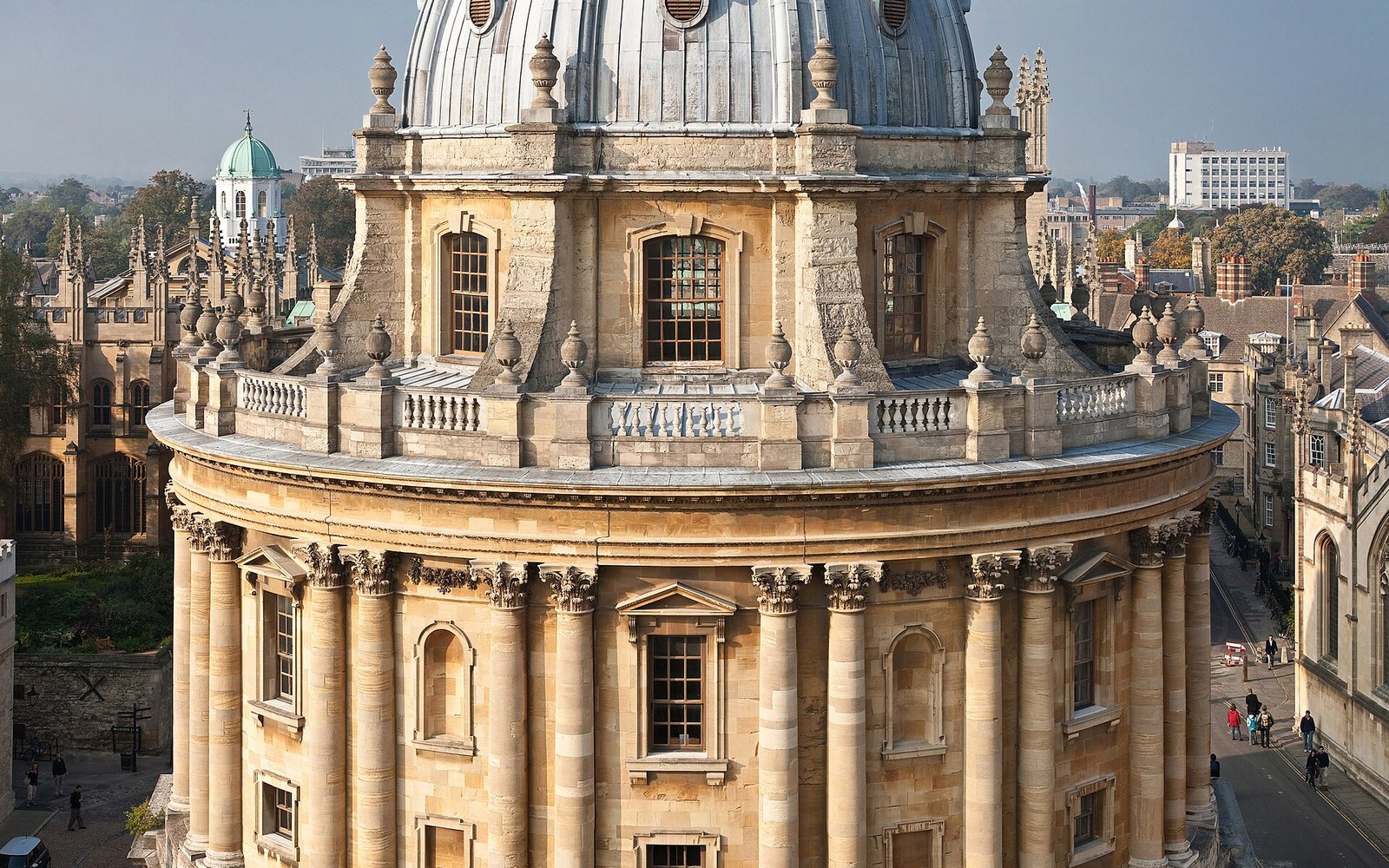
Start where the city reveals itself rather than hides: somewhere with a view. The cupola of the Sheldonian Theatre, Wren's ceremonial hall on Broad Street, earns you a proper orientation across the roofline — on a clear morning you see the Radcliffe Camera's dome, the spires of Merton and Magdalen, and the layered sandstone that gives Oxford its particular amber light. It's a short climb and a short stay; the Sheldonian isn't somewhere you linger, it's somewhere you look.
From there, the natural axis runs south and east into the heart of the old university. The Bodleian Library's Schools Quadrangle and the Tower of the Five Orders are visible from the street even when the main gate is closed — and the Divinity School, one of the finest late-medieval rooms in England, is accessible through ticketed tours when available. Don't confuse the Bodleian's outer precincts with the Radcliffe Camera across the square: the Camera is a reading room of the Bodleian, not a separate institution, and it isn't open for visitor browsing. Looking at it from Radcliffe Square costs nothing and is almost certainly enough. The round building against a blue sky is one of those things that actually does look like its photographs.
By mid-morning, before the crowds fully thicken, go to the Pitt Rivers Museum. This is the firmest recommendation this guide will make. It is free, it is extraordinary, and it is arranged in a way that actively rewards slow looking rather than punishing you for it. Enter through the Museum of Natural History — itself worth unhurried time, a Victorian Gothic cathedral of cast iron and glass where the architecture is as much the point as the specimens — and then push through into the Pitt Rivers at the back. You've now spent nothing and you're in two of the best museums in Britain. Give them at least ninety minutes between them; two hours is better.
The round building against a blue sky is one of those things that actually does look like its photographs.
Lunch is a decision about what you want. The Covered Market, a Victorian indoor trading hall off the High Street, has food worth eating that isn't aimed exclusively at tourists — though its character has shifted over the years and not everything in it repays the detour. Jericho, the neighbourhood northwest of the centre, is where a higher proportion of locals actually eat; it's a fifteen-minute walk and often worth it. Neither answer involves a queue outside a famous door.
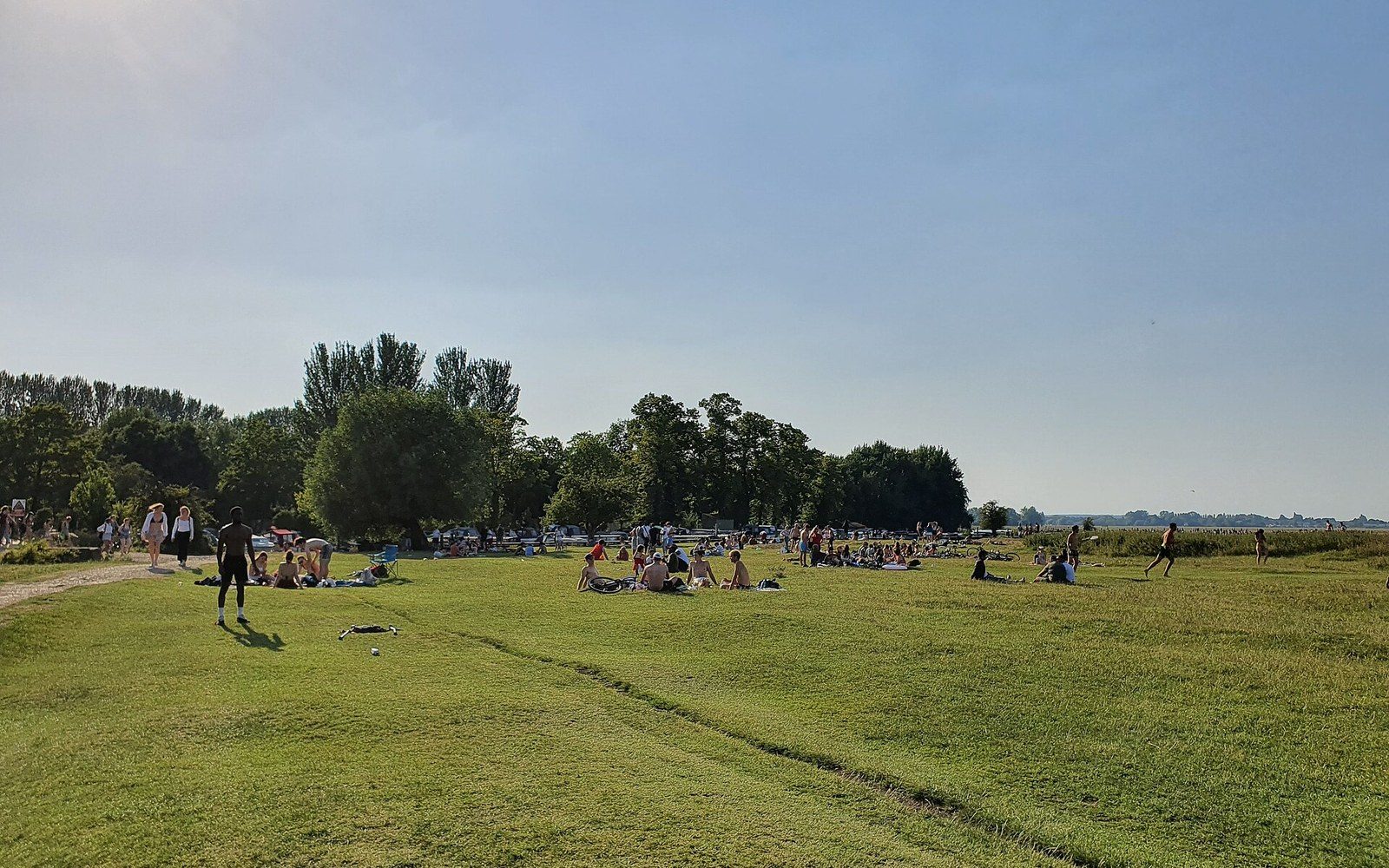
The afternoon is where most first visits go wrong: tired, over-stimulated, trying to fit in Christ Church. Christ Church is the most visited college in Oxford precisely because it has the most famous name attached to it. It also has the most reliable queue and a substantial entry charge. The Meadow it sits beside — Christ Church Meadow — is free, always open, and more beautiful than the college's public rooms. A circuit of the Meadow takes under an hour, follows the River Cherwell, and deposits you back in the city feeling like you've been somewhere real. That is not a consolation prize. It is, for most visitors, the better afternoon.
If you have energy left and the light is still good, the Botanic Garden rewards a slower pace than almost anything else in central Oxford — a walled garden beside the Cherwell with greenhouses and an informality that the university's grander precincts don't permit. The walk between Magdalen College and the Botanic Garden, along the High Street and down past the Cherwell bank, is the most quietly scenic urban mile Oxford offers.
What to skip without guilt
The Ashmolean Museum, on Beaumont Street, is Britain's oldest public museum and could easily take half a day by itself. See it on a second visit, when you have the headroom to give it. Don't squeeze it into a first day already carrying the Pitt Rivers and the Natural History Museum — you'll rush both and get less from each.
The much-photographed Bridge of Sighs — technically Hertford Bridge, spanning New College Lane — is worth a glance as you pass. It doesn't warrant repositioning your day around it. Likewise, the famous view from the top of Carfax Tower in the centre of town is perfectly fine and perfectly replaceable by the Sheldonian view, which is better.
Punting — taking a flat-bottomed pole-pushed punt on the Cherwell or the Isis — is a legitimate Oxford pleasure and a terrible first-day activity if you haven't allowed for it. It takes longer than you think, getting in and out is awkward, and if it's your first time you'll spend the initial twenty minutes going sideways. On a second or third visit, in the right weather, with no agenda: brilliant.
The honest summary
One day in Oxford, used well, gets you the skyline from the Sheldonian, the Radcliffe Square complex on foot, the two museums on Parks Road, a walk through Christ Church Meadow, and a proper hour at the Botanic Garden. That is not a compromise itinerary. That is a very good day. The colleges are the city's famous face, and you'll see plenty of quadrangles and gates in the natural course of walking — but the city's real attraction is the accumulated texture of seven or eight centuries of building, all in the same warm stone, all within a mile. It doesn't require a ticket. It mostly requires walking slowly.
- 17th centuryBodleian Library founded in its current form; Sheldonian Theatre built
- Victorian eraMuseum of Natural History and Covered Market constructed
Related