The Museum of Natural History
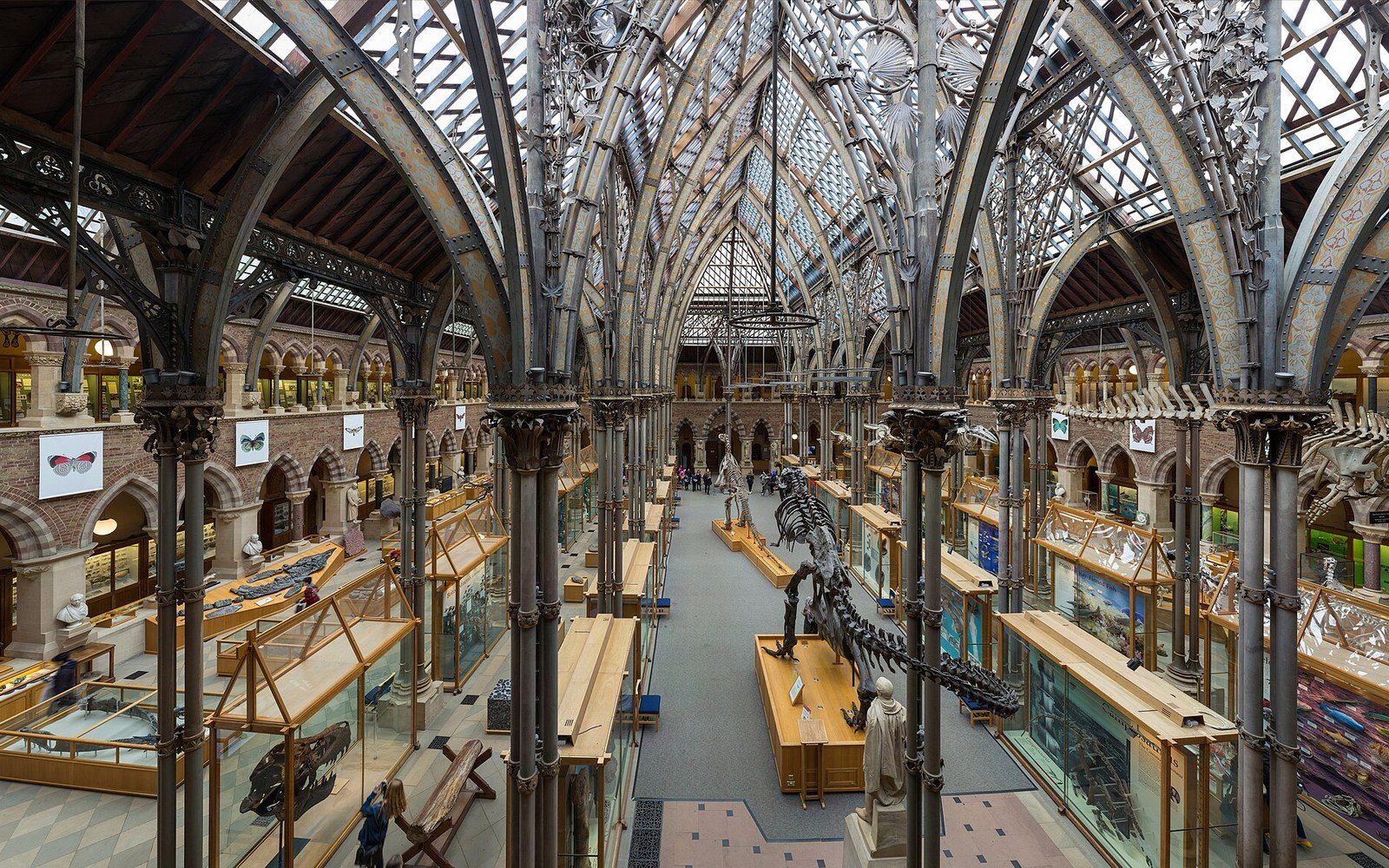
The building is the exhibit — cast iron and Gothic under glass.
The building is the exhibit — cast iron and Gothic under glass
The Oxford University Museum of Natural History sits on Parks Road, a short walk north of the Bodleian, and it is free to enter. Both of those facts matter, but neither is the main reason to go. The main reason is the building itself.
Iron and stone, together
The museum opened in the 1860s as a deliberate argument. Oxford's scientists had been lobbying for a dedicated home for natural science, and when they finally got one, the architects Benjamin Woodward and Thomas Deane gave them something that looked — consciously, polemically — like a Gothic cathedral applied to the problem of a lecture hall and specimen store. The exterior is Venetian Gothic in Cotswold stone, a style then championed by John Ruskin, who took an active interest in the building's construction. Whether you find the result handsome or overworked, it is unmistakably intentional.
The interior is where the building becomes genuinely strange. Step through the entrance and you are under a vaulted roof of cast iron and glass, the structure held up by slender iron columns dressed in decorative foliage. Natural light falls from above onto the collection on the floor below. The stone pillars around the court are cut from different British stones — each one labelled, each one a sample of the geology it represents. The carving on the capitals was left unfinished, partly because the craftsmen ran out of funding and partly because the project fractured into arguments. You can see the stopped work if you look: some capitals elaborate, some bare. The incompleteness has become part of the charm.
The whole thing reads as a Victorian attempt to hold two things together that the century was beginning to pull apart: natural philosophy and natural theology, science and beauty, iron and stone. It did not entirely succeed, but the effort is visible in every arch.
What the collection contains
The specimens inside are substantial. There are dinosaur skeletons — including a cast of a Megalosaurus, the first dinosaur formally described by science, described here in Oxford. There are mineral galleries, entomology collections, zoological specimens in cases that have barely changed in appearance since the nineteenth century. The dodo gets a prominent position: Oxford holds some of the best-preserved soft-tissue remains of a dodo in the world, and the display gives them the weight they deserve.
But honest guidance says this: the collection, taken alone, is good without being exceptional. Natural history museums in London and elsewhere have larger holdings. What Oxford's museum does that others cannot is put those specimens inside this building, and let the architecture do its share of the work. Walking the perimeter of the central court and looking upward is worth doing slowly. The iron columns thin toward the top; the glass catches whatever light the Oxford sky is offering. In grey weather it has a greenish, submarine quality. On a bright morning it is something else entirely.
Doing it the other way round, spending real time in the natural history building first, is the better order.
The museum also contains the entrance to the Pitt Rivers Museum, which sits directly behind it. The two are connected by a doorway at the back of the ground floor. The contrast between them — one a cathedral of classification, the other a dense Victorian cabinet of human culture — is part of what makes the pairing so effective. Most visitors come for the Pitt Rivers and pass through the Museum of Natural History without pausing. Doing it the other way round, spending real time in the natural history building first, is the better order.
When to go and how long to allow
The museum is free and has no timed entry. It draws school groups on weekdays during term, and families at weekends. The early morning is noticeably quieter, and weekday afternoons in the university's term time tend to be manageable once the morning groups have cleared. There is no trick to it, no back route — but because the central court is tall and open, the sense of crowding is less than in a museum with enclosed galleries. Even on a busy day you can find a corner to stand and look upward without obstruction.
Allow an hour if you are going straight through to the Pitt Rivers. Allow ninety minutes or more if you mean to read the geological columns, work around the dinosaur hall, and sit for a moment in the light of that glass roof. The Pitt Rivers will take as much time again on the other side of the door.
Parks Road itself is part of the experience. The museum sits across from the University Parks, and the walk from the town centre, past Wadham and up past Keble's muscular Victorian brick, gives you a sense of how Oxford spills north from its medieval core. It is a different Oxford from the High Street — wider, quieter, and less visited. The museum is the best single reason to come this way, but the walk earns its keep.
This guide carries no prices, opening times or event listings — they expire. Check anything time-sensitive on the day, at the door.
Related